01Who has to keep double-entry books?
This is governed by Art. 957 of the Swiss Code of Obligations (CO). What matters is the legal form and, for sole proprietorships, revenue:
| Legal form | Revenue | Bookkeeping |
|---|---|---|
| Sole proprietorship, general partnership | below CHF 500,000 | Simple bookkeeping (income, expenses, financial position) |
| Sole proprietorship, general partnership | from CHF 500,000 | Double-entry bookkeeping |
| GmbH, AG | any revenue | Double-entry bookkeeping, from the first franc |
So a GmbH or AG has no choice. It is a legal entity and must keep a balance sheet and income statement from the day it is founded, even if revenue is low in the first year. Which legal form suits you is covered in our comparison of legal forms. Everything that comes up during the year is covered in the guide GmbH accounting in Switzerland.
02What does double-entry bookkeeping mean?
Double-entry means every transaction is booked to two accounts, once as a debit and once as a credit. When a client pays an invoice of CHF 1,000, the bank account goes up and the open receivable goes down. The entry reads “Bank to Receivables”.
All entries together produce the two statements the law requires:
- Balance sheet: what the company owns on a given date (assets) and how it is financed (liabilities and equity).
- Income statement: revenue and expenses of a financial year, and therefore the profit or loss.
So that all companies book the same way, Switzerland uses the SME chart of accounts: 1020 is the bank, 1100 the receivables, 5000 wages. This is where most people get stuck. Which account goes on the debit side, which on the credit side? And what about VAT?
03New: events instead of journal entries
einzly Business turns the order around. You don't pick two accounts, you pick what happened: “Salary paid to employees”, “Dividend to shareholders resolved”, “Asset purchased”, “Loan received”. There are 66 templates. You fill in two or three fields, and einzly creates the entries on the SME chart of accounts.
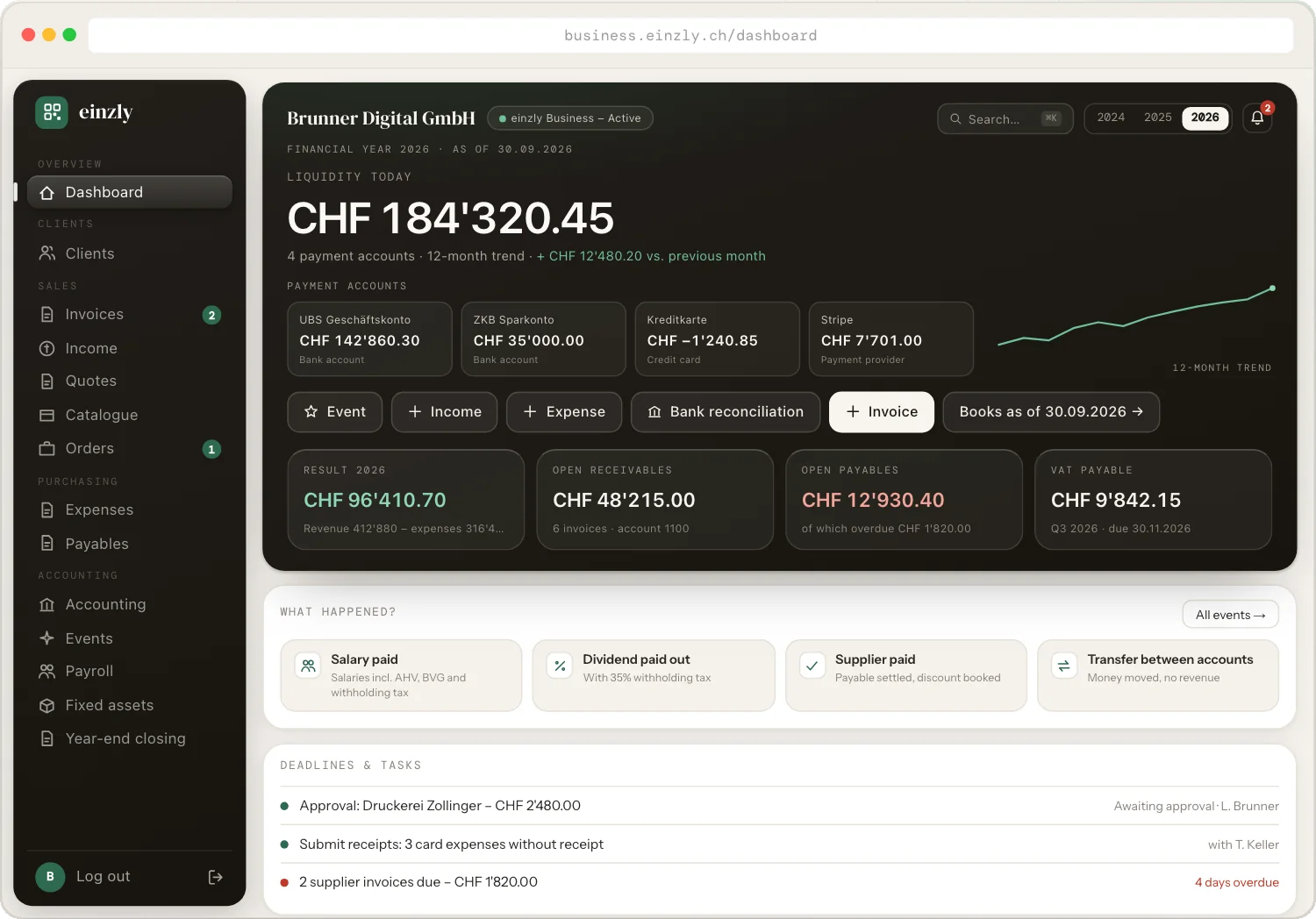
Example 1: salary paid
You enter the gross salary, the deductions and the employer contributions. For a gross salary of CHF 6,000, einzly books (amounts as an example):
| Account | Debit | Credit |
|---|---|---|
| 5000 Wages and salaries | 6,000.00 | |
| 1020 Bank (net salary) | 5,310.00 | |
| 2270 Current account AHV, IV, EO, ALV (deduction) | 390.00 | |
| 2272 Current account pension fund BVG (deduction) | 300.00 | |
| 5700 Social security expenses AHV, IV, EO, ALV | 390.00 | |
| 2270 Current account AHV, IV, EO, ALV (employer) | 390.00 | |
| 5720 Pension fund BVG | 300.00 | |
| 2272 Current account pension fund BVG (employer) | 300.00 |
Eight booking lines, without looking up a single account number. When you later pay the compensation office's invoice, you pick “Social insurance paid to compensation office”, and the current account is settled again.
Example 2: dividend resolved
The shareholders resolve a dividend of CHF 20,000. einzly first checks that there is enough distributable profit and that the statutory retained earnings reserve has been allocated (Art. 672 and 675 CO). Then it books:
| Account | Debit | Credit |
|---|---|---|
| 2970 Retained earnings / loss carried forward | 20,000.00 | |
| 2206 Withholding tax payable (35%) | 7,000.00 | |
| 2269 Declared distributions | 13,000.00 |
Paying out the shareholders and paying the withholding tax are separate events that build on the resolution. If you want the details, every entry is visible in the journal.
04What else einzly Business can do
- Payables and payment runs: record supplier invoices and load them into e-banking as a payment file (pain.001).
- Team with approvals: assign roles, have supplier invoices approved and request missing receipts.
- VAT: effective method or net tax rate, including export for the Swiss Federal Tax Administration portal.
- Fixed assets: keep a fixed asset register and book depreciation.
- Year-end closing: balance sheet and income statement under the CO, closing assistant and dossier for your fiduciary.
- Profit centres with budgets: revenue and expenses per division in a plan-vs-actual comparison.
- Bank reconciliation: import bank statements (camt.053/054) and match payments.
- Sales: QR invoices, quotes, orders and reminders, just as you know them from einzly.
All features at a glance are on the page accounting software for GmbH & AG.
Your fiduciary works right along with you
Most GmbHs have their fiduciary do the year-end closing. You invite them, and they work in the same books. Access is free. At year-end they receive the dossier with journal, trial balance, balance sheet and income statement.
05Switching from another accounting system
Whether you come from bexio, Banana or Abacus: you switch using the balances from your current books.
The easiest is the start of a new financial year. Switching mid-year works too.
From your previous software you need the balances of all accounts as of the cut-off date.
In einzly, pick the event “Opening balances (opening balance sheet)” and enter the balances.
Open customer and supplier invoices are part of the balance in the opening balance sheet. When they are paid, pick “Old customer or supplier invoice settled”.
What else to watch out for when switching is covered in the guide switching accounting software.
06How much does einzly Business cost?
There is a single plan with everything included: CHF 35 per month, or CHF 29 per month on the annual plan (CHF 348 per year), excl. VAT. Your team and your fiduciary work along at no extra cost. The first 30 days are free, no credit card needed.
07What changes for sole proprietors?
Nothing. einzly for sole proprietors stays what it is: simple bookkeeping without the clutter, at the same price. einzly Business is a separate product with its own account. If you later found a GmbH or grow beyond CHF 500,000 in revenue, you open a Business account and start with your opening balances.