01What the law requires of a GmbH
A GmbH is a legal entity. Under Art. 957 of the Swiss Code of Obligations (CO) it must therefore keep accounts and prepare financial statements, regardless of revenue. The relief for small sole proprietorships (simple bookkeeping below CHF 500,000 in revenue) does not apply.
- Double-entry bookkeeping: every transaction is booked as a debit and a credit. More in the article double-entry bookkeeping for GmbH & AG.
- Annual financial statements: balance sheet, income statement and notes (Art. 958 CO), prepared within six months of the end of the financial year.
- Retention: books, vouchers and annual financial statements must be kept for ten years (Art. 958f CO), digitally as well.
- Chart of accounts: the Swiss SME chart of accounts is not mandatory, but it is the standard. Fiduciaries and auditors expect it.
02Does every GmbH need an auditor?
No. The type of audit depends on the size of the company:
| Type | When | What is audited |
|---|---|---|
| Ordinary audit | Two of three thresholds exceeded in two consecutive years: CHF 20 m balance sheet total, CHF 40 m revenue, 250 full-time positions (Art. 727 CO) | Full audit |
| Limited audit | All other GmbHs, unless waived | Audit with reduced scope |
| Opting out | No more than 10 full-time positions on annual average and consent of all shareholders (Art. 727a CO) | No audit, entry in the commercial register |
Most small GmbHs waive the audit by opting out. The books still have to be complete and correct: the tax authority reviews the annual financial statements together with the tax return.
03What comes up every month
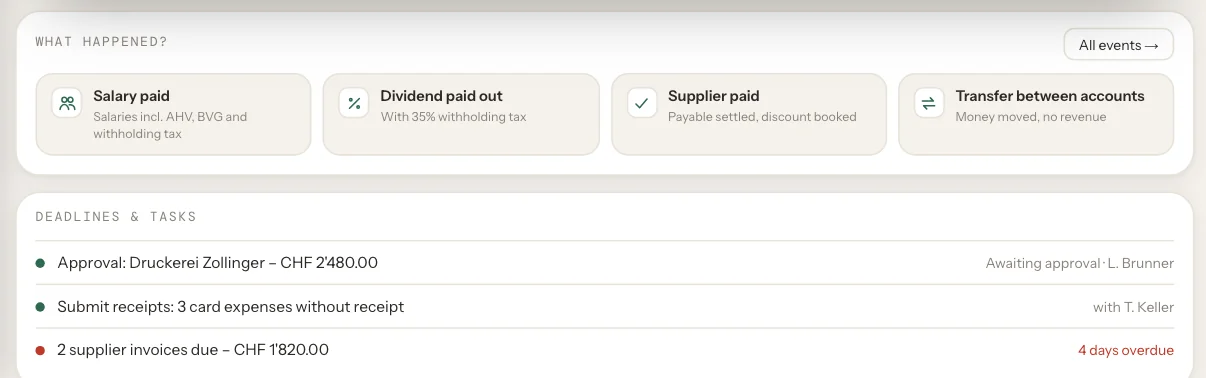
GmbH bookkeeping is not a year-end project. If you book as you go, there is little left to do at closing. Typical monthly tasks:
- Invoices and receivables: issue invoices, match incoming payments, remind late-paying clients.
- Supplier invoices and payables: record invoices, monitor due dates, trigger payments.
- Receipts: record receipts and card expenses with the voucher so that the input tax deduction is correct.
- Bank reconciliation: compare the bank statement with the books so that nothing is missing and nothing is booked twice.
- Payroll: pay salaries and book the deductions for AHV, ALV, BVG and accident insurance. For how to organise it, see outsourcing payroll or doing it yourself.
04What comes up every quarter
- VAT: from CHF 100,000 in annual revenue, the GmbH is liable for VAT. With the effective method you file quarterly, with the net tax rate every six months. How it works is explained in filing VAT with the Federal Tax Administration.
- Social insurance: the compensation office sends advance invoices for AHV, IV, EO and ALV, usually quarterly. At year-end the final settlement on actual salaries follows.
05What comes up at year-end
Accruals and deferrals for services that belong to the new year, depreciation of fixed assets, provisions and valuation of open customer invoices.
Balance sheet, income statement and notes. When opting out, without an audit report.
The shareholders approve the annual financial statements and decide on the use of profit, at the latest six months after the end of the financial year (Art. 805 CO).
Before a dividend, part of the profit must be allocated to the statutory retained earnings reserve (Art. 672 CO). Dividends are subject to 35% withholding tax.
The GmbH pays profit tax to the Confederation (8.5%), the canton and the municipality, plus a cantonal capital tax. The basis is the annual financial statements.
A checklist for the last weeks of the year is available in the year-end checklist.
06Things that only apply to a GmbH
- Salary of the shareholders: if you work in your own GmbH, you are an employee. The salary is subject to AHV and is booked like any other salary.
- Dividend: profit flows to the shareholders as a dividend, less 35% withholding tax. If the salary is noticeably low and the dividend high, the compensation office may treat part of it as salary.
- Shareholder current account: if you pay a company invoice privately or take money out of the company, it runs through the current account. Interest on loans between the GmbH and a shareholder is based on the rates the Federal Tax Administration publishes every year.
- Share capital: at least CHF 20,000. It is shown on the balance sheet and cannot simply be withdrawn.
07Do it yourself, use a fiduciary, or both?
The law does not prescribe who keeps a GmbH's books. Management remains responsible. In practice there are three models:
| Model | Your effort | Cost | Overview |
|---|---|---|---|
| Everything with the fiduciary | Collect and hand over receipts | Highest, depending on the number of entries | Figures often only weeks later |
| Book yourself, fiduciary for the closing | Book as you go, a few minutes a week | Software plus closing by the fiduciary | Up-to-date figures at any time |
| Everything yourself | Book as you go and do the closing yourself | Lowest | Up-to-date figures, but accounting knowledge needed |
For most small GmbHs, the middle model is the best compromise: day-to-day bookkeeping takes little time, and the fiduciary takes care of a clean closing and the tax return.
08How einzly Business helps
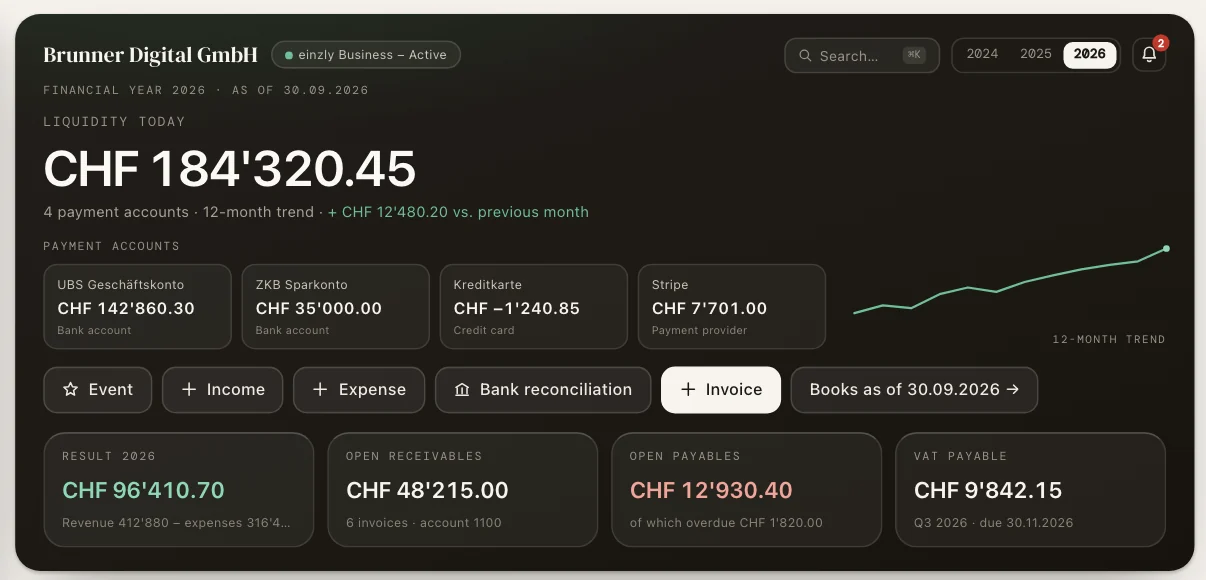
einzly Business is built for exactly this model. You record what happened, for example “Salary paid” or “Dividend resolved”, and einzly books debit and credit on the SME chart of accounts. The dashboard always shows liquidity, result, open receivables and payables, and the VAT payable.
- Payables with payment file (pain.001) for e-banking and approvals within the team
- VAT with the effective method or net tax rate, with export for the Federal Tax Administration portal
- Closing assistant for accruals, deferrals and depreciation
- Free access for your fiduciary, with a closing dossier
- One plan, everything included: CHF 35 per month or CHF 29 on the annual plan, excl. VAT